The Sporting Chronicles
A Weekly Record of American Sport
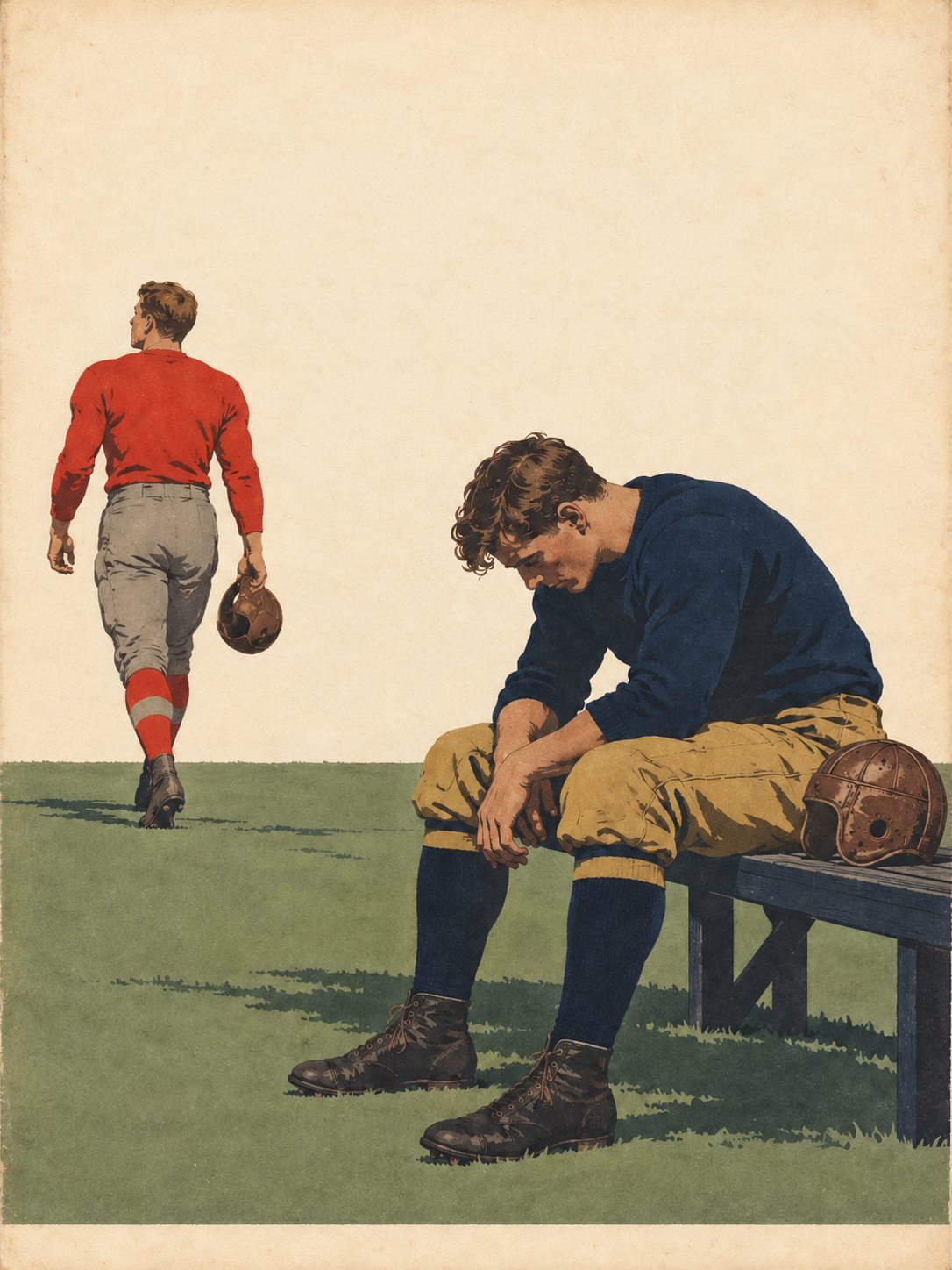
Ohio State Beats Michigan for the First Time
Harley’s run decides it, 13 to 3; Colgate beats Princeton and Dartmouth beats Cornell at the Polo Grounds.
Cover: original art made with AI.
OHIO STATE BEATS MICHIGAN FOR THE FIRST TIME, 13 TO 3
Harley Dodges the Whole Michigan Eleven for a Touchdown; Yost’s Team Out of the Conference Race
COLGATE’S FIRST TOUCHDOWN AGAINST PRINCETON WINS, 7 TO 0
Dartmouth Beats Cornell, 9 to 0, Before 18,000 at the Polo Grounds; W. and J. Beats Syracuse, 13 to 0
ANN ARBOR, Mich., Oct. 25.—Ohio State beat Michigan here on Saturday, 13 to 3, and it is the first time an Ohio eleven has beaten Michigan at football. In fifteen games since 1897 Michigan had won thirteen and two had been tied, and Michigan had scored 371 points to Ohio’s 21. Walter Eckersall writes in the Chicago Tribune that “the scarlet and gray of Ohio State triumphed over the maize and blue of Michigan today, 13 to 3, in a game which eliminated the Wolverines from the western conference championship and makes the Buckeyes a strong favorite for the title.”
In the East, Colgate made the first touchdown it has ever scored against Princeton, and won by it at Princeton, 7 to 0. At the Polo Grounds Dartmouth beat Cornell, 9 to 0, before 18,000, in the rubber game of their series. And at Syracuse the eleven that beat Pittsburgh a week ago was beaten on its own field by Washington and Jefferson, 13 to 0.
HOW OHIO DID IT
The Sun last Monday made Michigan the choice, but by only a slight margin; Eckersall, writing from Ann Arbor on Friday, found the betting at even money and little wagering done. On Tuesday he had written: “If Ohio State wins it will be the 1919 champion.”
Ohio scored in the first quarter on a blocked kick, and the accounts of it differ. The Sun’s special despatch says Huffman blocked the kick and Flower recovered it and ran fifteen yards for the touchdown; Eckersall says Meyers, the Ohio end, blocked Sparks’s punt and Flower fell on the ball behind the Michigan line. Harley kicked the goal. In the second quarter Sparks drop-kicked Michigan’s three points, from the 45-yard line by the Sun’s account and the 43 by Eckersall’s.
Harley scored the second touchdown shortly after the half. The Sun says Harley, “dodging the entire Michigan eleven ran forty yards for the final score. He missed the goal.” The Tribune’s headline makes the dash forty-five yards, and Eckersall says Harley got past Sparks with “his inimitable change of pace and sidestepping.” On defence, the Sun reports, “He broke up every forward pass attempted by Michigan.” The Tribune’s notes add: “Capt. Harley certainly was a marked man. He was tackled hard every time the Michigan players got him, and they didn’t handle him otherwise in tender manner.”
The Sun names Stinchcomb, the all-West quarterback, and Flower, at right end, as Ohio’s other stars; Eckersall names Bliss and Stinchcomb. Michigan lost Rye on the opening kick-off with a broken leg. Athletic Director Bartelme put the crowd at about 25,000, with 2,500 from Columbus. Ohio is coached by Jack Wilce, a former Wisconsin player, and Eckersall calls his team “as powerful and evenly balanced a team as has graced a western gridiron in years.” Coach Yost had no excuses to offer. Ohio has Purdue, Illinois and Wisconsin still to play.
Chicago beat Northwestern, 41 to 0, and that was the game the Chicago Tribune put across the top of its football page; Harvey T. Woodruff’s headline says Stagg’s machine has arrived as a title contender. Wisconsin beat Illinois at Urbana, 14 to 10, and Iowa beat Minnesota at Minneapolis, 9 to 6, when Devine drop-kicked a goal from the 30-yard line after his first try had been blocked.
COLGATE 7, PRINCETON 0
PRINCETON, N. J., Oct. 25.—“Never did a Princeton football team fight harder than did the sons of Old Nassua in the Palmer Memorial Stadium this afternoon,” Daniel writes in the Sun. “Never did a Tiger eleven show more courage in the face of odds.” Colgate had gone in a 7 to 10 favorite, and the Sun had guessed the score at about 14 to 0. “Princeton was defeated cleanly and decisively,” says Daniel, “but with all that, it exceeded expectations, for it held the Colgate eleven to only one touchdown.”
In the third period Princeton stopped Gillo on fourth down within two feet of the line. Then Trimble, punting from seven yards behind his own goal, got the ball out only to his 32. A pass, Anderson to Gillo, made twenty-two yards, and Gillo plunged twice. “Then Anderson ran back and threw a forward pass to Watkins,” the Sun says. “The latter stepped just one yard over the line and Colgate had scored the first touchdown it had ever made against Princeton.” West kicked the goal. In the last period Trimble ran nineteen yards behind the posts, but Referee Langford had already whistled Princeton offside, and the touchdown did not count. Before Saturday, Princeton had scored 81 points against Colgate and Colgate none. Colgate has now beaten Brown, Cornell and Princeton.
DARTMOUTH 9, CORNELL 0
George B. Underwood of the Sun gives the day at the Polo Grounds to two Dartmouth men, Adolph Youngstrom and Jim Robertson: “The eternal vigilance of the one and the cunning toe of the other enabled the Green to flaunt above the Red in the rubber game of the gridiron series between Dartmouth and Cornell.” The two had met only twice before: Cornell won in 1900 and Dartmouth in 1912. Dartmouth was the favorite, and the New York Times says football ran true to form, “in one of the hardest fought games ever seen in New York.”
In the third period Youngstrom broke through, blocked Shiverick’s kick and got the ball on Cornell’s 18, and Robertson and Holbrook carried it down until Robertson went over; he missed the goal. Later in the quarter Murphy blocked another of Shiverick’s kicks, but this time Cornell held for downs on its 1-yard line. Robertson also kicked a field goal. He “kicked the goal forty-seven yards against the wind and up an incline,” Underwood writes. “The ball struck the cross bar, but Fortune, ever favoring the brave, decreed that it should bounce over the right side for a score.” The Sun’s own headline makes it a kick from the fifty-yard line, and the Times says from practically the halfway mark. “Cornell was defeated but not disgraced,” says the Sun; Dartmouth’s lighter line outplayed the heavier Cornell forwards.
SYRACUSE BEATEN AT HOME
Washington and Jefferson beat Syracuse at Archbold Stadium, 13 to 0, a week after Syracuse had beaten Pittsburgh. It was a punting duel between Eielson of W. and J. and Ackley of Syracuse until the last six minutes, when Erickson, another W. and J. back, ran back two punts for touchdowns, one of fifty yards and one of fifty-five from his own 45-yard line. Stein kicked one goal. The Sun picks out Wilbur Henry, the W. and J. right tackle, an All-America player of 1916. Syracuse made six first downs to four.
THE REST OF THE EAST
Harvard beat Virginia in the Stadium, 47 to 0, on seven touchdowns, two of them by Arnold Horween, who also made a run of thirty-seven yards to within a foot of the line. Yale beat Tufts in the Bowl, 37 to 0; “Fido” Kempton scored two touchdowns and French kicked a field goal. Yale played without Callahan, Joe Neville and Thorne Murphy. We reported last week that Murphy’s left leg was feared broken. The X-ray showed no break: a ligament below his left ankle is injured, and the Sun says he will not play before the Brown game, perhaps not before Princeton comes to New Haven. Acosta, whose passes from centre gave Boston College its safety, goes back to tackle, and Calvin takes Callahan’s place.
The Army beat Boston College at West Point, 13 to 0, a week after Boston’s victory in the Bowl; McQuarrie outkicked Fitzpatrick, and the first score came when Kieffer fell on a punt that Corrigan fumbled on Boston’s 25. Pittsburgh beat Georgia Tech, 16 to 6, the first defeat for Heisman’s eleven this year; Davies dropped a field goal from the 25, and Judy Harlan carried the ball over for Tech in the second half. Pennsylvania beat Lafayette at Franklin Field, 23 to 0, with General March in the stand; Bert Bell kicked a field goal from the 38 and Ben Derr scored twice in the third period.
At South Field, Columbia beat Amherst, 9 to 7, and ended Amherst’s unbeaten run; Captain Canapary drop-kicked a goal from the 47-yard line and threw the pass for the touchdown. New York University beat Rensselaer at Ohio Field, 9 to 0, its first points and first victory of the season, under its new associate coach, Gargan, late of Fordham.
THE WEST AND SOUTH
Notre Dame beat Western Normal of Kalamazoo, 53 to 0, and Nebraska and Oklahoma played a 7 to 7 tie at Lincoln. On the coast Washington State beat California at Berkeley, 14 to 0, and Stanford beat the Oregon Aggies, 14 to 6. In the South, Georgia beat Florida at Tampa, 16 to 0, and Vanderbilt beat Auburn, 7 to 6. Centre College has lost Tanner, its quarterback, whom the faculty has ruled ineligible. The Sun says Centre showed St. Xavier’s of Cincinnati no mercy on the 18th and is picked to share Southern honors with Georgia Tech, but no score of that game, nor of Saturday’s game with Transylvania, has reached New York.
SATURDAY’S SCORES
| Ohio State 13, Michigan 3 | Chicago 41, Northwestern 0 |
| Colgate 7, Princeton 0 | Wisconsin 14, Illinois 10 |
| Dartmouth 9, Cornell 0 | Iowa 9, Minnesota 6 |
| W. and J. 13, Syracuse 0 | Notre Dame 53, Western Normal 0 |
| Harvard 47, Virginia 0 | Michigan Aggies 27, De Pauw 0 |
| Yale 37, Tufts 0 | Nebraska 7, Oklahoma 7 |
| Army 13, Boston College 0 | Missouri 3, Drake 0 |
| Pittsburgh 16, Georgia Tech 6 | Georgia 16, Florida 0 |
| Pennsylvania 23, Lafayette 0 | Vanderbilt 7, Auburn 6 |
| Columbia 9, Amherst 7 | Clemson 14, Tennessee 0 |
| Navy 21, Bucknell 6 | Tulane 27, Mississippi 12 |
| Penn State 48, Ursinus 7 | Washington State 14, California 0 |
| Holy Cross 69, Conn. Aggies 0 | Stanford 14, Oregon Aggies 6 |
| N. Y. U. 9, Rensselaer 0 | Virginia Poly 6, Maryland State 0 |
The Sun’s table gives Harvard 35 points and the Bee’s gives Virginia 2; the Sun’s own story and summary, which add up the seven touchdowns and five goals, make it 47 to 0. The Bee credits the victory over Georgia Tech to the University of Pennsylvania.
THE PROFESSIONALS
The scores of last Sunday’s games, which had not reached us at our last closing, came in the Akron Beacon Journal of Monday. Jim Thorpe’s Canton Bulldogs, “defending the United States open title here Sunday,” beat the Columbus Panhandles at Canton, 22 to 3, on touchdowns by Calac, Chamberlain and Guyon and a safety. It is the first Canton score we have been able to print. At Detroit, 10,000 saw Massillon beat the Heralds, 17 to 0, and Stanley Cofall of Notre Dame, a Cleveland boy, was the sensation of the game. The Akron Indians beat Pitcairn, 47 to 0, before 3,500, and Cleveland beat the Hammond eleven of college stars, 6 to 0, on drop kicks by Ralph Gordon and John Scott.
“Joe Guyon of Carlisle Indian and Georgia Tech fame, is doing double work this fall,” the Sun reports. “He is coaching the eleven of Union University, Jackson, Tenn., and is jumping from Jackson into Canton, Ohio, every Saturday night to play Sunday games with Jim Thorpe’s team.” Daniel notes that George Halas, after a poor season with the Yankees and St. Paul, “now is playing professional football.” Ed Bang, sporting editor of the Cleveland News, asks in Collyer’s Eye: “WHY not a professional football league to take the place of the major baseball leagues after the world’s series has ’passed along?’” He names eight cities, Cleveland, Hammond, Canton, Massillon, Akron, Columbus, Toledo and Detroit, where the clubs pay college men anything from $100 to $1,000 a game. Yesterday’s games had not been reported when this number closed.
AROUND THE BIG LEAGUES
JUSTICE WAGNER ENJOINS BAN JOHNSON IN THE MAYS CASE
Court Finds the League President’s Knowledge of the Facts Imperfect; Ruth Wants $20,000 or He Will Not Play for Boston
Ban Johnson has lost the first inning of the Mays case, as the Evening World’s headline puts it. Justice Robert Wagner of the Supreme Court has granted the Yankees’ motion for an injunction, with costs, restraining Johnson from suspending Carl Mays. The Sun gave it a banner across one of its sports pages yesterday, and says the president of the American League “received a staggering jolt.”
What kind of injunction it is depends on whom you read. The Sun’s banner calls it permanent, and its story says Johnson is permanently enjoined. The opinion it prints ends: “The motion for an injunction pendente lite is therefore granted, with costs”; that is, an injunction until the suit is tried. The Evening World says it was granted pending the trial, and the wire in the Bridgeport Times and the Chicago Tribune calls it a temporary injunction, though the Yankees’ lawyers, the Tribune’s wire says, hold that it is in effect permanent. The Evening World and the Sun put the decision on Saturday; the Bridgeport wire is dated Friday.
The opinion rests on the clubs’ property in their players. “It is undisputed and indeed a matter of common knowledge that the commercialization of baseball is a highly profitable undertaking,” Justice Wagner writes, and the property of the clubs “consists principally of contracts with individual players with reputation for skill and ability in playing the game.” To interfere with one player, he holds, “would confuse and possibly destroy the rights of the respective clubs and their players, for the validity of the games in which Mays participated might be questioned.” The Yankees had spent $75,000 to get Mays from Boston.
The court sets out the facts. At Chicago on July 13 Mays, who had had family trouble and whose home in Pennsylvania had burned with all his baseball trophies, was struck in the head by a ball thrown by the catcher, and left the field. “He was found sitting in the clubhouse with his head between his hands and crying bitterly.” Then he was sold to the Yankees, and Johnson suspended him. “It does not appear necessary to pass on the motives which actuated the president in suspending Mays,” the Justice writes. “His act may possibly have been arbitrary. At the time of the suspension his knowledge and information concerning the real facts were imperfect.” Johnson did not ask whether Boston had disciplined the player, and did not call Mays before him, and so his act “was, to say the least, not fortified with that perfect appreciation of the facts which evinces a desire to do equity to all parties concerned.”
The Sunday papers we have seen carry no word from Johnson, Ruppert, Huston or Frazee, and nothing on what the Commission will now do with the Yankees’ third-place money, still held up on Navin’s protest.
THE TALK ABOUT THE SERIES
Frederick G. Lieb, in the Sun last Monday, gave part of a column on players’ salaries to the talk about the series. “When one takes into consideration that practically every American has played baseball or understands the game,” he wrote, “it is amazing that there have been so many hints, suggestive remarks and shakings of the head in regard to the last world’s series.” He has covered most of the series between the two leagues, and never, he says, has he seen such a lack of confidence in the integrity of one. A man back from the series is asked on every side whether it was really on the level.
Lieb does not believe it. “How could a series like that be fixed and kept quiet?” he asks. “Three hundred of the country’s leading sporting experts saw the series, and not one of them saw the slightest thing that might be regarded with suspicion. And they were men who know baseball.” He traces many of the mean stories to “sore head gamblers who lost heavily on the Sox,” beginning with those who backed Cicotte in the first game and saw him hit hard. The best pitcher, he says, is likely to get a hammering.
Harry Neily’s story from Chicago, which we described last week from Maxwell’s account of it, appeared in full on Monday in the Washington Times. Neily says it sets at rest the rumors that any of the White Sox were fixed: three gamblers, he writes, spread word before the series that seven of the Sox had been bought, and played both ways. He says Gleason went to St. Louis with “Tip” O’Neill, Comiskey’s right-hand man, to confer with friends, and talked with men there who bet on races and ball games. The Chicago wire we printed last week had Gleason deny that the trip had anything to do with the gambling stories. Neily says nobody has come forward to claim Comiskey’s $10,000 (Maxwell had it $20,000), and doubts that anybody ever will.
Collyer’s Eye, the Chicago betting weekly whose banner last week said seven of the Sox were involved, ran a second article on Saturday by the same correspondent, Frank O. Klein. This time it names players, Cicotte, Williams, Felsch and Risberg, and sets its charges down as things “alleged” or “charged.” It tells of a fight in the club house in which, it says, Schalk accused Williams of throwing the game, and it quotes an unnamed bookmaker who says he refused a bet of $2,000 on Cincinnati brought to him, he was told, with Williams’s money. Next week, it says, it will publish the names of the Sox players its inquiry has cleared. We have not seen the story taken up by any other paper.
Eddie Collins says the Reds caught the Sox in a batting slump that began on their last trip East; a Sun writer finds the statement not particularly gallant and thinks Collins’s own slump may have been due to Ring’s fast ball and Eller’s shine ball. I. E. Sanborn of the Chicago Tribune finds a rule broken in the series that, he says, was overlooked. In the seventh game Eddie Collins was called out for blocking Kopf’s throw on a double play, and yet John Collins was allowed to stay on third, and scored on Jackson’s hit. “Under the present code the recent world’s series might have terminated in a wrangle if the White Sox had won out at the finish,” Sanborn writes, “because everybody in the National league except Henry O’Day overlooked a palpable violation of the rules in the seventh game of the series. It gave the Sox a run and they won that game.” He wants protests after the fact barred before next season.
RUTH ASKS $20,000
Babe Ruth has gone to Los Angeles to act in moving pictures, and says he will not come back to Boston at his present salary. “I will not play with the Red Sox unless I get $20,000,” he said in Boston. “I feel that I made a bad move last year when I signed a three years contract to play for $30,000. The Boston club realized much on my value and I think that I am entitled to twice as much as my contract calls for.” The papers do not agree on the contract. The Sun said on Thursday that Frazee had signed him for three years at $12,000 a year; Ruth’s own figure comes to $10,000. The Chicago Tribune says the contract has two years to run, and that he “will not be seen on the diamond again unless a considerable increase is forthcoming.” Frazee was in Boston on Saturday and had nothing to say.
Ruth played in New York before he left. At Dyckman Oval a week ago yesterday he was in left field for Guy Empey’s Treat ’Em Roughs and made two hits in three times at bat, one a double, but Schang’s All Stars won both games, 10 to 3 and 5 to 2.
The Red Sox are not for sale, Frazee says, though Congressman Gallivan says Boston friends of his have made an offer. “The club is not in the market and I cannot understand the basis for the present report.” Lieb reports a newer story, that Lannin, who is still being paid for the club, will take it back if this year’s payment is not made, and he does not think it rings true. Everett Scott says he will not play another season in Boston.
THE COMMISSION AND THE CLUBS
The National Commission has given Waite Hoyt, the former Brooklyn schoolboy pitcher, to the Red Sox for $2,500, though Frazee was willing to pay $4,000. The Commission had ruled that Hoyt belonged to New Orleans and that Boston might buy him at a fair price. Frazee wired an offer of $2,500, New Orleans wired an acceptance, and a storm held up the telegram four days, in which time Frazee had agreed to $4,000. The Commission holds that the acceptance would have closed the deal had it been delivered promptly, but it finds no excuse for Boston’s dealing with Hoyt directly.
President Heydler announces that Roush of Cincinnati, not Hornsby, is the National League’s leading batsman, .320 to .316, Hornsby’s .322 having been a miscount; the Sun says no lower average has ever led a major league. National League owners, Lieb reports, are framing, for the December meeting, a rule against deals between clubs of the league after July 1.
The Giants disbanded for the winter last Monday after a barnstorming trip on which they won twelve of fourteen games. President Fultz of the International League says the end of the draft was one of the greatest blessings that ever came to the minor leagues, and Jack Dunn estimates he made about $50,000 this year by it. The minor leagues meet at Springfield on November 11.
Brooklyn’s testimonial to Jimmy Ring has not been reported; a “Jimmy Ring Day” was set for yesterday at Dexter Park. We have no report of the New Britain banquet to Kopf.
THE INDEPENDENT CLUBS
WASHINGTON, Oct. 25.—Howard University beat Shaw University on the Howard campus on Saturday, 6 to 0, in the last minutes of play. It was the first meeting of the two in eight years, and the Evening Star says the game “has a direct bearing on the colored championship of the south.” For three quarters the Shaw line held. Then it weakened, and Smith of Howard broke through, blocked a Shaw kick, recovered the ball and ran thirty yards for the touchdown. Howard has now won from Storer, 63 to 0, and from Shaw. The score of the opening game with Virginia Theological Seminary has still not reached this office.
At Rock Island the Independents beat the Davenport A. C., 33 to 0, last Sunday before 6,000, and Marshall, at right end, had a hand in it. The Argus now gives his name: “Young Bobby Marshall was just like a father to both teams. He never missed a chance to help a prostrate player to his feet.” Playing back on defence he broke up many passes, and he caught one over the line for the second touchdown. At New Haven the Sun allows that Martin, the colored halfback of Tufts, gave Yale more than one scare in the first half. Iowa beat Minnesota on Saturday; the despatches that have come here do not say whether Fred Slater played.
NEW YORK, Oct. 26.—Dick Rudolph of the Braves did pitch at Ebbets Field a week ago yesterday, and the International League stars beat the Bacharach Giants twice, 7 to 4 and 6 to 1, with Johnny Enzman in the box for the second game. “Although Rube Marquard of the Brooklyns and Walter Smallwood of the Yankees were on the mound,” the Sun reports, “the Lincoln Giants yesterday twice humbled the All-Leaguers at Olympic Field, each time by a score of 5 to 0.” Williams held the Leaguers to three scattered hits. The Brooklyn Royal Giants beat the Emeralds at the Catholic Protectory, 12 to 10, with six runs in the eighth inning, Ryan pitching and Santop catching.
Yesterday’s games had not reached this office when we closed. The Bacharachs were to meet the Internationals again at Ebbets Field, with Dick Redding named for the second game, and the Lincolns were to meet Empey’s Treat ’Em Roughs at Dyckman Oval in the first of three double-headers for what the papers call the semi-professional championship of Manhattan; Empey has signed Barnes, Doyle and Frisch of the Giants, and Barnes was to pitch against “Cyclone Joe” Williams. Hilldale’s rubber game with Summers’s All-Americans on the 18th has not been reported in any paper we have seen.
KANSAS CITY, Oct. 25.—“Rube” Foster’s Chicago Giants beat the All-Stars at Association Park, 9 to 6, the Kansas City Sun reports. Foster used three pitchers, Donaldson, B. Williams and Davey Brown, to make sure of the victory, and “Ty” Lyons hit a home run with the bases full. The paper calls it the final contest and the Giants’ one victory in three games; its own advertisement on the same page calls the meeting a five-game series, the All-Stars two up, with a double-header yesterday “for championship,” and adds: “Rube swears he has never been beaten a full series.” Yesterday’s result had not come in.
THE RING
WILLS TOO STRONG FOR JEANNETTE AT THE NEW ARENA
Brennan Beats O’Dowd; Langford Given the Tulsa Belt After a Draw; Dempsey Willing to Box Abroad; Lynch Cancels With Herman
Dave Driscoll opened his Arena A. C. in the Fourth Regiment Armory at Jersey City last Monday night, and the Sun counts 5,000 in the house. Harry Wills of New Orleans, 209 pounds, beat Joe Jeannette, 204, in eight rounds, putting him down for nine in the second and again in the eighth. It was their first meeting in six years. The Sun says Wills took “honors in every round,” and adds: “The mill was so one sided that the crowd repeatedly called upon Referee Harry Lewis to stop it; not that Jeannette was in a bad way at any time, but because the contest bored the spectators.” The Evening World says Wills was inclined to be lenient with the popular Hoboken boxer; the Chattanooga wire says only that he shaded him. On the same card Bill Brennan, 196, beat Dan O’Dowd, 173, in eight rounds. Driscoll lost money on his first show, but expects to get it back on Friday.
TULSA, Okla., Oct. 22.—Sam Langford has the belt, though the referee would not give him the fight. Lem Wallace called his fifteen rounds with Jack Thompson at Convention Hall on Monday night a draw. The Tulsa World says “Langford forced the going throughout and was clearly victor, landing more often and with greater power than Thompson,” and gives him eight rounds to Thompson’s two, with five even. Thompson’s left eye was closed at the finish; Langford was unmarked. The Kansas City Sun calls it “a very unpopular decision,” and says the old master “has lost none of his ’kick.’” (The California Eagle puts the fight on Tuesday night; the home paper says Monday.)
The next night Walker Machen, the promoter, presented the diamond-studded belt to Langford anyway, declaring that Sam had clearly earned it. Langford has agreed to defend it against Harry Wills at Tulsa at an early date, possibly before Thanksgiving, and the winner is to keep the belt. The World writes that Langford is practically as good “as when he was leading contender for the world’s heavyweight crown then worn by Jack Johnson.” It says Wills and Langford have met twice, Wills winning the first time and Langford the second, at St. Louis this summer; the New York Sun, a week ago yesterday, counted a knockout of Langford in seven rounds as Wills’s best credential. Ray Pearson of the Chicago Tribune writes that Langford is now “the colored heavyweight champion of the world.”
The bout between Benny Leonard and Johnny Dundee, announced for Hartford to-night, is written of this week as though it will not be held. The Sun writes of Leonard’s refusal to go fifteen rounds to a referee’s verdict with Dundee there, and Hartford, like New Haven, insists on decisions. Dundee is matched with Willie Jackson at Milwaukee on Friday, and Wisconsin requires boxers to be in the city five days ahead; he is also matched with Tommy Tuohey at Newark on election night. No notice that the Hartford bout is off has reached us.
Dempsey still has no match. The Sun reports that he and Jack Kearns “would prefer to have Beckett and Carpentier come to America for a battle for the world’s championship, but if they refuse the title holder will, on the receipt of proper inducements, go over to Europe and give battle to the Englishman and the Frenchman on their own stamping grounds.” A New Orleans syndicate, through Dominick Tortorich, has offered $150,000: for Dempsey and Beckett, says the Evening World; for Dempsey and the winner of Beckett and Carpentier, says the Sun. Beckett and Carpentier are now fixed for December 4 in London, twenty rounds, and the wire says that, under tentative agreements, the winner is to meet Dempsey in the spring.
Joe Lynch has called off his title bout with Herman at New Orleans. He telegraphed Tortorich: “Can’t see my way clear to accept match with Herman for championship on the terms signed for.” The Sun says he puts the dollar above the title. A Philadelphia despatch of a week ago had the pair signed instead for the Olympia A. A. on November 12. Mike O’Dowd, the middleweight champion, and Mike Gibbons, both of St. Paul, are matched for ten rounds at St. Paul on November 21; they have never fought.
The A. A. U. boxers, Donze, Cassidy and Burke, have been held up once more, by want of passports, the Sun says, and by the marine strike, says the Evening World. They are to sail to-day by the Evening World’s account, though the Sun’s shipping list has the Stavangerfjord leaving for Bergen on Tuesday. They will box in Norway, Denmark and Sweden.
THE TURF
THE PORTER WINS THE LAUREL STAKES BY EIGHT LENGTHS
New York’s Season Ends at Empire City; Busy Signal Runs Away With the Golden Rod; Stoneham and McGraw Buy the Havana Track
LAUREL, Md., Oct. 25.—E. B. McLean’s The Porter won the Laurel Stakes (the Sun calls it the Laurel Handicap) at a mile on Saturday by eight lengths, on a slow track, with Billy Kelly second and Sun Briar third. Lucullite, the even-money favorite, could not untrack himself in the going; the Racing Form has him fourth, and the Sun has him last of six. On Tuesday The Porter, carrying 125 pounds, set a new track record for the mile. Only three started in that race; Sir Barton, who had been expected, did not.
C. A. Stoneham and John J. McGraw, who control the Giants, have bought a majority of the stock of the Cuba-American Jockey Club, which runs Oriental Park at Havana. A Sun column doubts the other National League owners will look kindly on racing interests in the hands of the men who own the New York club, since baseball, it says, is trying its hardest to kill gambling.
Empire City closed on Saturday before the largest crowd of its year, and with it racing in New York for 1919. A. K. Macomber’s Star Master won the Victory Handicap, and Clarence Kummer took the association’s gold watch as leading rider of the meeting. At Churchill Downs, which opened on Thursday with attendance and betting almost double last year’s, King Gorin won the Falls City Handicap, and on Saturday E. R. Bradley’s Busy Signal ran away from fifteen two-year-olds in the Golden Rod and won by twelve lengths. Be Frank stays for the Louisville Cup on Saturday, the last day of racing in Kentucky this year.
Pimlico opens on Saturday for eleven days, to November 13, with about $130,000 to be distributed. Sir Barton is to start in the Pimlico Autumn Handicap, which the Racing Form puts on November 5 and the Washington Herald on November 6, and will probably carry top weight; Hildreth thinks Mad Hatter, Lord Brighton or Thunderclap can give him one of the battles of his life. Purchase wrenched an ankle at Laurel while being keyed up for a special race with Sir Barton. Man o’ War leads the year’s winners with $83,325, the Racing Form reports, but he is in retirement, and Sir Barton, it says, is so close that he seems certain to pass him before the Maryland meetings end.
BREVITIES
Hoppe kept the 18.2 balk-line championship at the Hotel Astor, winning all six of his games and beating young Schaefer on the last night, 400 to 214 by the Sun’s headline and 400 to 211 by its story. Referee Peterson handed him a diamond-studded trophy, which becomes his own if he defends it successfully in the next two annual tournaments. With it go a $2,500 purse and an annual salary of $4,000 from the Brunswick-Balke-Collender Company. Cochran made an unfinished run of 265 against Slosson on Friday, which the Sun calls a new world’s record, and the same night beat Schaefer and made the title safe for Hoppe. Cochran and Morningstar divided second and third money.
Fred Faller of the Dorchester Club, winner of the A. E. F. modified marathon in France, took the national ten-mile title from Charlie Pores of the Millrose A. A. at the Brooklyn Athletic Field on Saturday, winning by nearly a lap from Terry Halpine; Pores dropped out in the seventh mile. Willie Plant beat Dick Remer, the holder, in the seven-mile walk.
Pierre A. Proal of Deal won the New York Athletic Club’s golf championship at Fox Hills. Miss Katherine Aiken of Mamaroneck, sixteen and playing in her first tournament, won the girls’ junior Metropolitan tennis title at Forest Hills. Springfield College beat Yale’s soccer team in its opening game, 2 to 1. Walter J. Salmon has been named to the American Olympic Athletic Committee.
COMING EVENTS
| Date | Event |
|---|---|
| Monday, Oct. 27 | A. A. U. boxers to sail for Scandinavia (the Stavangerfjord is listed for Tuesday). |
| Tuesday, Oct. 28 | Bob Martin, A. E. F. heavyweight champion, makes his professional debut, Akron. |
| Friday, Oct. 31 | Johnny Dundee v. Willie Jackson, Milwaukee. Pal Moore v. Patsy Johnson, Arena A. C., Jersey City. |
| Saturday, Nov. 1 | Louisville Cup; Churchill Downs closes. Pimlico autumn meeting opens. Brown v. Syracuse. Stecher v. Lewis, wrestling. |
| Tuesday, Nov. 4 | Syracuse v. Rutgers, New York. Dundee v. Tuohey, First Regiment Armory, Newark. |
| Wednesday, Nov. 5, or Thursday, Nov. 6 | Pimlico Autumn Handicap (Sir Barton to start). |
| Saturday, Nov. 8 | Michigan v. Chicago, Stagg Field. Bowie Cup, Pimlico. |
| Tuesday, Nov. 11 | Minor leagues meet, Springfield. |
| Wednesday, Nov. 12 | Lynch v. Herman, Olympia A. A., Philadelphia (Philadelphia report). |
| Thursday, Nov. 13 | Pimlico Cup; Pimlico closes. |
| Friday, Nov. 21 | Mike O’Dowd v. Mike Gibbons, ten rounds, St. Paul. |
| Thanksgiving Day | Cornell v. Pennsylvania. |
| Saturday, Nov. 29 | Army v. Navy, Polo Grounds. A. A. U. national cross-country championships, Van Cortlandt Park. |
| Thursday, Dec. 4 | Beckett v. Carpentier, twenty rounds, London. |
ADVERTISEMENTS
THE COLD STANDS OF NOVEMBER. Ulsters of heavy Scotch cloth, $30 to $50. Box coats for town, $35 to $45. BRANDT & ROWE, Clothiers, 1284 Broadway.
THE GRIDIRON BY WIRE. Every Saturday the principal college games, play by play as the operator receives them, on the big board. Harmon Hall, 43d Street near Broadway. Doors open at 2 o’clock. Admission 25 cents, plus war tax.
A HAT FOR THE BIG GAMES. Soft felts in the fall shades, $4 and $5. Derbies, $5. Tweed caps for the open stand, $1.50. KELLER’S, 210 Nassau Street.
BACK NUMBERS. Nos. 1 to 4 of this paper, with the whole of the world’s series, may still be had at this office. Five cents each; by mail, seven.
THE SPORTING CHRONICLES is published every Monday. Subscription, $2.50 a year; single copies five cents. Correspondence on matters of sport is invited, and will be answered in these columns.
About this magazine. The Sporting Chronicles reports real American sport in the manner of a weekly of its time. This issue closed at about eleven on Sunday, October 26, 1919, and prints only what was public by then. When the newspapers of the day gave different accounts of the same thing, we do not quietly or strategically choose one. We print both. It quotes no one directly unless the words have been checked against the printed page. The ads are written in the style of the period, to give a feel for a magazine of the day. The companies in them are made up, but the prices are true to the time. Everything else is fact. The cover is original art made with AI. Written by AI, to rules its publisher set.