The Sporting Chronicles
A Weekly Record of American Sport
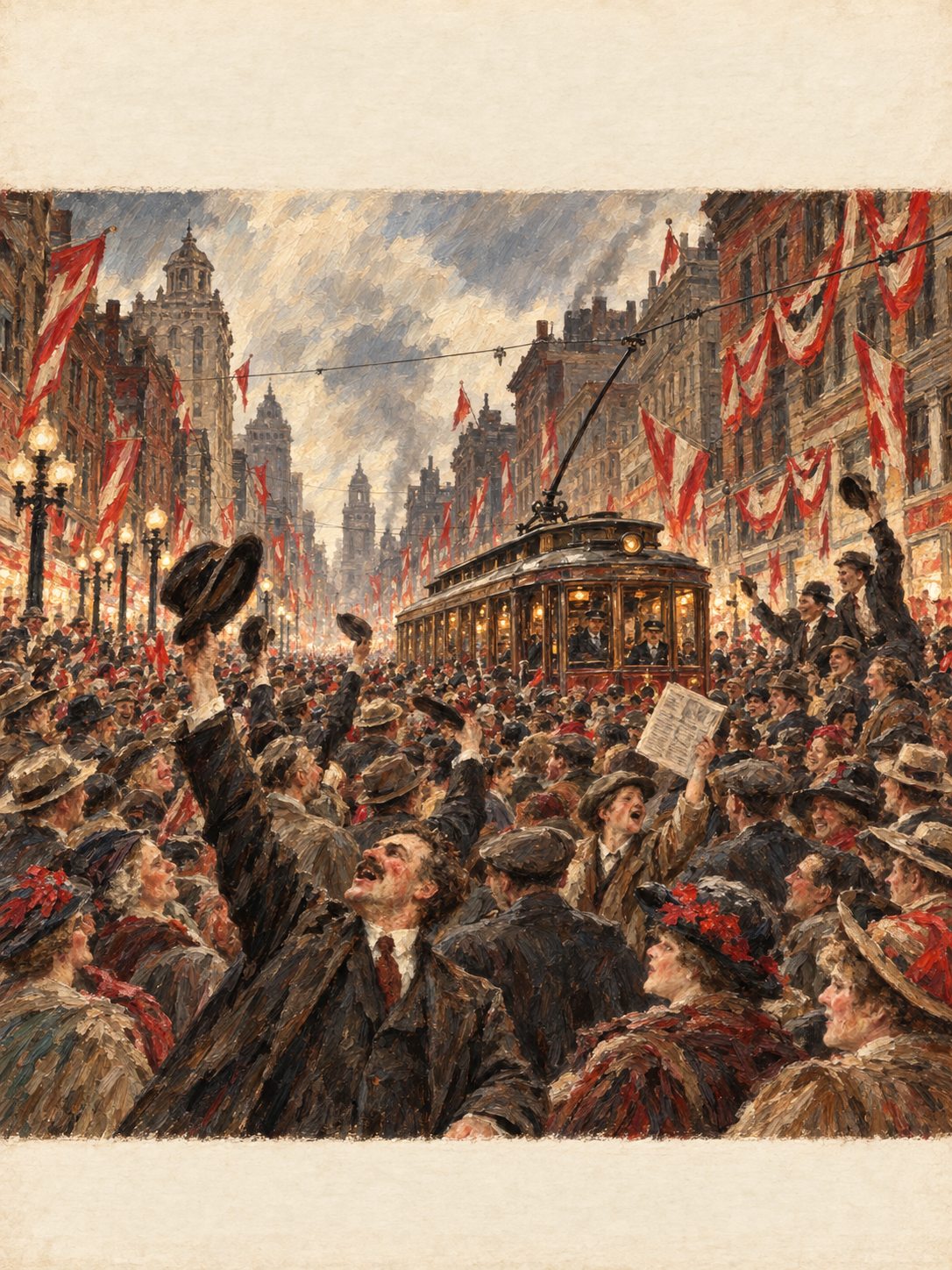
Cincinnati Wins the World's Series
The Reds beat the White Sox five games to three, and the city takes a holiday.
Cover: original art made with AI.
CINCINNATI WINS THE WORLD’S SERIES, FIVE GAMES TO THREE
Reds Drive Williams Out in First Inning of Last Game and Win, 10 to 5
ELLER WINS TWICE, AND SHUTS SOX OUT ON MONDAY
Kerr and Cicotte Win in Cincinnati; City Takes Holiday to Greet Moran’s Men
CHICAGO, Oct. 9.—The Cincinnati Reds are the champions of the world. They beat the White Sox at Comiskey Park this afternoon, 10 to 5, in the eighth game of the series, and took the series five games to three. The game was decided in the first inning, when the Reds made four runs off Williams before he had put out more than one man. Eller, who shut the Sox out on Monday, pitched the whole game and won his second victory of the series.
After Sunday’s rain Eller’s shutout on Monday put the Reds four games to one, and a championship banquet was ready in Cincinnati on Tuesday. They needed one more victory, and it took them three days to get it. Kerr won in ten innings at Redland Field on Tuesday, Cicotte won on Wednesday before a crowd less than half the size, and the series came back to Chicago. Moran sent Eller back on Thursday, and it was over in the first inning.
No National League club had won the championship since the Boston Braves in 1914, and the Reds have beaten the club most of the experts picked to win.
THE FIFTH GAME: CINCINNATI, 5; CHICAGO, 0
Monday at Chicago was clear and cool, with the outfield soggy and the infield dry and fast. The crowd was smaller in the bleachers at noon than on the Friday or Saturday, and grandstand tickets could be bought at par in the morning, but by game time 34,379 had paid their way in.
Hod Eller gave them very little to cheer. He allowed three hits and one pass, and he struck out nine men, six of them in a row: Gandil, Risberg and Schalk in the second inning, and Williams, Leibold and Eddie Collins in the third. The New York Sun calls the six in succession a new world’s series record. Only two Chicago men got as far as third base. The Sox had their best chance in the first, when Leibold walked and Weaver’s single bounced off Eller’s glove, putting men on first and third with one out, and Moran sent Luque out to warm up. Jackson popped to Groh and Felsch flied to Duncan, and Moran was heard to tell Daubert that the boy had found himself.
Williams matched him for five innings. The sixth was the White Sox’s undoing. Eller drove the ball to deep center with two strikes on him, and when the throw-in got away from Risberg he went on to third. The accounts differ on how: the New York Tribune says the relay was deflected; the Sun says Felsch’s throw was high and Risberg muffed it. Moran ran out and put a sweater on his pitcher. Rath singled him home, Daubert sacrificed, and Groh walked. Then Roush lifted a fly to center that Felsch got his hands on and dropped, and Rath and Groh scored. The scorers gave Roush a triple, which the Sun says only the most liberal scoring could allow. McGeehan, in the Tribune, wrote that Roush was officially the hero of the inning but that there was no hero in it, only a goat, and his name was Felsch.
When Groh was called safe at the plate, Schalk swung at Umpire Rigler, who ducked. Schalk then threw his mask toward Jimmy Ring, who had come over from the Cincinnati bench to talk, and Rigler put him out of the game. The Sun says no player had been put out of a world’s series game since Frank Chance in 1910. Lynn caught for the rest of the afternoon. Duncan’s fly to Jackson brought in Roush with the fourth run, and in the ninth Eddie Collins fumbled a grounder, his first error in a world’s series since 1913 by the Sun’s count, and the Reds got another.
Before the game Herrmann’s little German band paraded the field playing “O Tannenbaum,” and Comiskey’s band answered with a march. Afterward Moran told the reporters: “It’s all over but the shouting. We’ll win again to-morrow, no matter who Gleason pitches.” Of his pitcher he said: “Eller pitched one of the greatest games that ever won a world’s series to-day. He couldn’t be touched, that’s all.” Lieb and McGeehan both write that Eller was once White Sox property, let go rather than paid for. Grantland Rice wrote that the Cincinnati pitchers had held the Sox to one earned run in forty-five innings.
THE SIXTH GAME: CHICAGO, 5; CINCINNATI, 4 (TEN INNINGS)
At Redland Field on Tuesday the Reds led by four runs and lost in the tenth. It was an ideal Indian summer day. The Sun’s correspondent wrote that “not even the vaguest suspicion of a cloud showed in the deep blue dome that covered the arena,” and that most of the crowd “sat in their shirtsleeves.” A third of the grandstand, by his count, were women, with the usual sprinkling of red hats among them. Before the game a delegation of Texas oil men gave Dickey Kerr a gold watch.
The Reds scored twice in the third, when Daubert singled and stole second, Kerr hit Roush with a pitch, and Duncan doubled to right center. In the fourth Neale tripled, Ruether doubled him home, and when Rath grounded to Risberg, the shortstop’s throw toward third hit Ruether on the shoulder and Ruether scored. That made it 4 to 0.
The Sox came back. In the fifth Ruether walked Risberg and Schalk and Kerr beat out a hit, filling the bases with none out. They got only one run of it, on Eddie Collins’s fly, and Kerr was caught between first and second and tagged out by Groh, who walked over from third to do it. McGeehan said it looked like bush ball. In the sixth Weaver’s short fly fell between Kopf and Duncan for two bases, Jackson singled him home, and Felsch doubled Jackson home. Moran took Ruether out for Ring, and Schalk’s single tied the score. The Sun reports that Weaver, coming in on Jackson’s single, never touched the plate, and that Rariden did not notice and no play was made on him.
Ring and Kerr held on until the tenth. Then Weaver doubled to left, and Jackson bunted and was safe when Rariden fumbled. Felsch struck out. Gandil chopped a single over Kopf’s head, and Weaver came in with the winning run.
Thousands who could not get into the park stood around the newspaper bulletin boards downtown and cheered every Cincinnati hit. When the Sox were flashed as the winners, the Sun reports, there were groans, and then a general rush to cancel railroad reservations. Moran said afterward: “To-day’s game was a heartbreaker for the Reds to lose. We should have won it half a dozen times. But the strain of the world’s series is beginning to tell on my players and they were a bit unnerved.” Rice wrote that no club in any past world’s series had changed its form so suddenly as the Sox did, and gave the credit to Weaver, Schalk, Kerr and Gandil. McGeehan found the game as loose as ashes, but said it was the only one so far with anything like a thrill in it.
THE SEVENTH GAME: CHICAGO, 4; CINCINNATI, 1
Cicotte asked for the ball on Wednesday morning, and Gleason gave it to him. The veteran had told his manager that if the Sox got him a couple of runs early, the Reds could not break him down. They got him one in the first, when John Collins singled, Eddie Collins sacrificed and Jackson singled; one in the third, on Jackson’s single past third; and two in the fifth, when Groh and Rath fumbled grounders in turn and Felsch singled to center. Moran walked out to the box and took Sallee out for Fisher. The Reds got their only run in the sixth, on Groh’s double and Duncan’s single. Cicotte allowed seven hits, and the game took an hour and forty-seven minutes.
Gleason had moved Felsch to right field, where the sun would not trouble him, and put John Collins in center. With two men on in the fifth Moran sent up Ruether, the hero of the first game, to bat for Fisher, and told him that if he had a triple left in his bat, now was the time for it. Ruether fouled out to Weaver.
Only 13,923 paid their way in, the smallest crowd at a world’s series game since 1909. The morning had been cold, 48 degrees, and people got out their overcoats, though it was fine by noon. The Sun puts most of the blame on Herrmann, who announced that no seats would be sold until one o’clock, an hour before the game, and asks how anybody could imagine that 32,000 seats could be sold in an hour. Herrmann himself came out ten minutes before the game, looked over the stands and put the crowd at barely fifteen thousand. McGeehan blamed Cincinnati: “The thing happened in a park that was half empty. The bugs have wearied of the series and the local nuts seem to have abandoned the team and everything connected with it.”
Moran said Cicotte was the master that day and that he would pitch Eller the next day. Gleason said his men had gone into the game with the old dash that won the pennant, that they were right now, and that they would beat Eller. Damon Runyon writes that Cicotte’s baseball obituary is now recalled from circulation, and that the Sox have shown they have what baseball calls, uncouthly, the guts. Runyon also reports that Moran had an umpire look over Gandil’s glove during the game.
The National Commission announced that Cincinnati had won the toss, and that a ninth game, if one was needed, would be played at Redland Field on Friday.
THE EIGHTH GAME: CINCINNATI, 10; CHICAGO, 5
It was over in the first inning. Thursday morning in Chicago began wet, under heavy black clouds, but the sky cleared as the morning wore on, and the sun was strong enough to bother the outfielders all afternoon. Rath popped out. Daubert and Groh singled, Roush doubled past first base, and Duncan doubled over Weaver’s head into the left-field corner. Three runs were in, and Gleason took Williams out and sent in James. James walked Kopf and struck out Neale, but Rariden’s Texas-leaguer over first scored Duncan, and it was 4 to 0. Lieb writes that there was nothing fluky about the hits; they were all solid pokes. Gleason said afterward: “If Williams had shown some ’stuff’ in the first inning it would have been a different story to tell to-night. But he didn’t have a thing except a desire to beat the Reds.”
The Reds added one in the second, an inning in which Groh was spiked by Gandil and lay on the ground for some minutes, and one in the fifth, when Kopf tripled and scored as Weaver and Risberg got tangled on Neale’s grounder. Jackson hit a home run into the right-field bleachers in the third, the only home run of the series. In the fourth Leibold threw Eller out at the plate on Daubert’s single, which McGeehan called as fine a piece of fielding as the series had seen. In the sixth James and then Wilkinson gave up three more runs on Eller’s single, a pass, a wild throw by Schalk and singles by Roush and Duncan, and in the eighth Rariden singled Roush home to make it 10 to 1. Hundreds of the crowd had gone home by the sixth inning.
The Sox gave those who stayed something to shout about in the eighth. Eddie Collins singled and Weaver doubled down the right-field line. Jackson doubled both of them home, and Gandil’s fly, which Neale lost in the sun, went for a triple. Risberg’s fly, which Roush dropped, brought Gandil in. Four runs were in, Moran went out to the box more than once, and Ring warmed up. Eller stayed in. In the ninth Roush ran down Leibold’s long drive, and Jackson, with two out, grounded to Rath, who threw to Daubert, and the world’s series of 1919 was over. Bulger, in the Evening World, says the Chicago crowd gave Eller a great ovation, and the Chicago Tribune says it cheered the former Sox cast-off every time he came to bat. The Chicago paper also reports that the Sox, evidently thinking Eller was mutilating the ball to make it hop, asked Umpire Nallin to examine it again and again.
Moran said: “The Reds are champions and I am the happiest man in the world to-night. I cannot praise my players too highly.” He added that the Sox were no quitters but a game lot of players who had fought to win and been outclassed, and he admitted they had given the Reds a scare. Gleason said the Reds had been lucky to win the early games, but that they had beaten the Sox in one of the greatest series ever played: “my hat is off to them. But I still believe the Sox is the better ball club.”
HOW CINCINNATI TOOK IT
The news of the last game reached Cincinnati through the bulletin boards, where thousands had gathered. The Associated Press reports that joy ran at flood tide that night, and that impromptu processions marched through all sections of the city.
The team came home on Friday morning. The acting mayor, Carl Jacobs, proclaimed a public holiday from eight o’clock until noon, many business houses stayed closed, and the schools let out. The Reds’ train reached the Central Union station a little after seven, and it seemed, by one Cincinnati dispatch, that half the city was there to meet it. “Hats were thrown into the air,” it reports, “and men, with their arms around one another’s necks, performed weird and extemporaneous dances. Women, many of them wearing hats of vivid crimson, climbed on the iron railing between the train shed and the depot proper and screamed at the top of their voices.” Moran had to salute constantly in answer to the cheers. Church bells, fire bells and the whistles of the factories, the steamboats and the locomotives joined in.
The players fought their way to automobiles and rode to the Business Men’s Club for breakfast, through the downtown streets, with the windows and sidewalks full along the way and fans on foot following the cars. The Cincinnati Times-Star, as reprinted in Kentucky, says the banners were flung out and were still flying. A rally and sing had been called for Fountain Square at ten o’clock. It rained, the rally was put off, and the players went out to Redland Field instead, held their last meeting of the season and waited for their checks. The cry most often heard at breakfast asked who had taken the glee out of Gleason.
HOW CHICAGO TOOK IT
Chicago’s rooters stayed with their club to the end. At Orchestra Hall, where the Chicago Tribune ran an electric scoreboard for the family of a railroad flagman crippled in a wreck, 1,168 fans paid fifty cents each on Thursday to watch the last game, and inning after inning, the paper says, they begged the little figures on the board for a rally. A huge crowd stood in Grant Park watching its free board on Michigan Avenue. The Chicago Tribune says the Sox fans rooted to the last out and gives Moran and his men full credit: in most of the games, it says, the Reds played the better baseball. It adds that the result has left breaches in the club’s harmony, with such resentment toward some of the players who did not come up to expectations that changes in the team before next season are likely. Mr. and Mrs. Comiskey plan a trip to Excelsior Springs to recover from the excitement.
After Monday’s shutout the Sun’s correspondent wrote that the city was brooding in an atmosphere of helplessness, and McGeehan that it had ceased to worry over the series. McGeehan pictures Comiskey ducking for the nearest exit after Thursday’s first inning. I. E. Sanborn, in the Chicago Tribune, wrote that Cincinnati’s fans had come into their own after half a century of waiting, and that the Reds had burned up the White Sox on the anniversary of the day Mrs. O’Leary’s cow burned up most of Chicago, forty-eight years before. Gleason congratulated Moran and still holds that his is the better club. Comiskey says that although the extra games helped his club this time, he is as much opposed to a nine-game series as ever, and he believes the public would rather have a short one.
THE RUMORS
Comiskey Offers $20,000 for Evidence of Fraud
President Comiskey of the White Sox said at Chicago on Friday night that he would give $20,000 for a single clew leading to evidence that any of his players had deliberately tried to throw a game of the series to Cincinnati. He said he was sure of their fidelity. Some of the players, the dispatch adds, had taken to heart rumors, given considerable circulation, that a few of their number might have played for money. “These yarns are manufactured out of whole cloth and grow out of bitterness due to losing wagers,” Mr. Comiskey said. “I believe my boys fought the battles of the recent world series on the level, as they have always done.” The New York Tribune printed his offer on its front page on Saturday, and his denial again on Sunday; the New York Times carried it too. The Chicago Tribune, which tucked it into a story on ticket sales, gives the figure as $10,000.
The rumors were heard in both cities, and the Sun gave them a headline across its sports page on Saturday. In Cincinnati, after the Reds lost on Tuesday, many fans argued that the club had lost on purpose to lengthen the series for the owners’ benefit, and Wednesday’s thin crowd was taken as a sign that the town believed it. The Sun’s correspondent there called it “the customary uncalled for and ridiculous charge of hippodroming.” It was said there too that Duncan and Kopf had let a fly fall in Tuesday’s game for a consideration, and that Ruether had not been in condition to pitch it. In Chicago it was said that Cicotte had been paid to lose his games, and that five members of the club had been given $100,000 by gamblers.
In Chicago the talk had begun earlier. After Kerr’s victory on Tuesday, I. E. Sanborn wrote in the Chicago Tribune that the Sox’s work “silenced all the dangerous gossip that had been circulated by disgruntled gamblers.” After the last game the same paper reported that stories were out that the Sox had not put forth their best effort, and that the big gamblers had got to them; its man, James Crusinberry, wrote that they “all sounded like alibi stuff even if true.” Gleason offered no excuse but the Reds’ better baseball. “I don’t know yet what was the matter,” he said. “Something was wrong. I didn’t like the betting odds. I wish no one had ever bet a dollar on the team.” On Sunday Sanborn wrote that baseball men fear what the betting cliques are doing to the game.
Daniel, writing from Chicago for the Sun, set the stories down. He reports talk there that there will never be another world’s series and calls it buncombe, born of the ugly rumors that went around both cities during the series. The stories hurt baseball, he says, but they will do away only with the nine-game series, and he holds that both clubs played up to their true form. Hugh Fullerton, in a column printed on Friday in the Hearst papers and others, thinks Thursday’s game was in all probability the last world’s series game ever to be played, if the owners value the good name of the sport, and that it meant the breaking up of the White Sox, with seven men who will not be with the club next spring; but he puts the defeat down to overconfidence and tells his readers to forget “the suspicious and evil minded yarns.” Lieb, in the same paper, regrets that the cries of “fake” and “frameup” heard from one end of Cincinnati to the other after Tuesday’s defeat “left quite a stain on the city’s honor.” On one point Lieb goes further: he writes on Sunday that the reports about Ruether’s condition in the sixth game are unfortunately true, and that he kicked over the traces while the series was on. McGeehan, in the Sunday New York Tribune, writes that “there was a lot of bad baseball perpetrated during the struggle for the world championship, but nothing worse.” He thinks the high prices and the big money drew the petty gamblers, and he asks for a reorganized National Commission headed by a man of judgment and standing, before stories like these are believed.
WHAT THE EXPERTS SAY
The experts, who mostly picked Chicago, now mostly give the series to the Cincinnati pitchers. Lieb, in the Sun: “Cincinnati’s victory was clean cut and well earned. The Reds played better baseball than the White Sox and had by far the better pitching.” He adds that when Chicago’s two best pitchers failed, Gleason had nothing but pitchers of American Association grade to send in to relieve them, while Moran’s staff is the best in the land. Bozeman Bulger, in the Evening World: “Above all, this series has convinced experts of the game that a world’s championship is merely a question of pitchers.” Bulger names Eller the real hero of the series, but finds that most of the games smacked of the town lot.
Not everyone was pleased with the play. Runyon called the last game “a sort of burlesque touch to a show that for a couple of days gave signs of becoming quite a drama,” and McGeehan called it the most loosely played game of a loose series. McGeehan also blames the magnates, who stretched the series to nine games for the money; he says the Reds would have been champions days sooner without it, and that which is the better club will be argued all winter. The Sun reports that the spectators “would rather have had the series over in the regulation limit of other years.”
Lieb, writing again on Sunday, finds the victory not only deserved but good for the game. The National League had won only one of the nine series before this one and was being spoken of as just a step above the American Association, and evenly matched leagues make for lively competition.
AROUND THE BIG LEAGUES
Navin Protests Mays’s Games; Yankees’ Third-Place Money Held Up
RUTH HITS ONE AT RUTLAND
The National Commission has held up the Yankees’ share of the players’ money for third place in the American League. President Navin of Detroit protests that the games Carl Mays won for New York were illegal, since President Johnson had suspended Mays and he played only under a court injunction. Colonel Ruppert’s answer was printed on Saturday. Mays pitched, he says, under a Michigan court order of August 14 that forbade Detroit to interfere with his contract or to refuse to play its games against New York, and the league’s directors set aside Johnson’s suspension that same day. Detroit made no complaint while it was in second place, and filed its protest only on September 20, to take effect if New York finished third. The Commission, in Ruppert’s view, has no authority to hold the money, and he finds that Mr. Navin’s protest confirms his opinion of the gentleman’s sporting caliber.
Babe Ruth hit his advertised home run, with two on, at Rutland, Vermont, on Sunday, October 5, and the Red Sox beat the local club, 6 to 2. He is said to expect about $25,000 between now and spring practice from the pictures, semi-professional games and vaudeville, and has engaged William Gallagher to manage his affairs. He brings a team of American League stars to Ebbets Field to-day for two games against a team from the International League.
We have seen no word of a city series in New York or Chicago.
THE INDEPENDENT CLUBS
DYCKMAN OVAL, New York, Oct. 5.—The Treat ’Em Roughs evened matters with the Bacharach Giants this afternoon, and took both games of the return double-header, 1 to 0 and 4 to 3, before the record crowd of close to fifteen thousand. Carl Mays got his revenge on Dick Redding for the fourteen-inning defeat of a week ago, winning the first game by the one run of the afternoon. Jeff Tesreau took the second, though the Bacharachs batted him hard and made twelve hits. Wickware pitched for the Atlantic City club.
SHIBE PARK, Philadelphia, Oct. 7.—The New York Giants of the National League beat the Bacharach Giants here this afternoon, 7 to 5, but they had to come from behind to do it. The game, announced for Monday, was put back a day. The Bacharachs drove five runs across in the fifth inning and led, 5 to 1. The Polo Grounders tied the score in their next turn at bat, hitting “Cannonball” Redding hard, and won it with two runs in the eighth. Rube Benton pitched for New York, with Snyder catching; Redding and Gatewood were the Bacharach battery. Manager Tom Jackson’s men were to close their season at Shibe Park on Saturday against the Disstons, who had played them three times without a decision, and the result was not at hand when this number closed.
In New York on Sunday, October 5, the Lincoln Giants took two games from the All-Leaguers at Olympic Field, 2 to 0 and 6 to 1, over Ray Keating and Al Demaree. Two New York papers disagree on which game was which. The same afternoon at Dexter Park the Brooklyn Royal Giants surprised the Bushwicks, the semi-professional champions of Brooklyn, by winning both games, 3 to 1 each, in two games full of sensational fielding. The Lincolns were billed again for yesterday against George Mogridge and a team of big leaguers, with “Cyclone” Joe Williams to pitch, but no score had reached this office.
Rube Foster, manager of the Chicago American Giants, watched the series from Box 109 at Comiskey Park with Joe Green, manager of the Chicago Giants, and Walter Ball, star pitcher of the Chicago Giants. The Whip reports that Professor Foster and Mr. Ball were among those who picked the Reds to beat the White Sox after the first two games, and the Whip holds that any effort to excuse the Sox by luck or the breaks of the game is an insult to the sterling work of the Reds.
On the college gridiron, two colored players are with the Northwestern squad, Sam Peyton at halfback and Buddy Turner at tackle. Walters, formerly of Howard, has been declared eligible at New York University. Howard University was to open its own season on Saturday against Virginia Theological Seminary and College, and Coach Robinson expects a team such as Howard has not known in many years, but the score had not reached New York when this number went to press. Howard P. Drew, who shares the world’s records at 100 and 220 yards, is to make his home in New York and practise law.
THE RING
WILLIE JACKSON STOPS MORGAN; FACES TUOHY TO-NIGHT
Carpentier Declines $80,000 to Meet Dempsey in Six Rounds; Champion Off to the Circus
Willie Jackson knocked out Eddie Morgan of England at Philadelphia last Monday night, and he meets Tommy Tuohy at the First Regiment Armory, Newark, to-night. Dave Mackay’s card for the Newark Sportsmen’s Club also has Pete Herman, the bantamweight champion, against Harold Farese, and Al Roberts against Charlie Weinert and Benny Valger against Frankie Brown, thirty-eight rounds in all.
At Scranton on Friday night a bout between Frankie Brown and Tommy O’Toole ended in the sixth round when O’Toole claimed a foul. A free fight followed, the police were called to stop it, and O’Toole went to the hospital. At Denver the same night Lew Tendler stopped Stanley Yoakum, who quit in the fourth round of a scheduled twelve.
Georges Carpentier has turned down $80,000 for a six-round bout with Jack Dempsey. The Frenchman says he will meet the champion for the title after his bout with Joe Beckett in December. Dave Mackay has wired Dempsey an offer of $25,000 to box Battling Levinsky eight rounds at Newark early in December. Another report says he will not fight again this year. In the meantime the champion is to travel through Texas with the Sells-Floto circus.
Benny Leonard meets Phil Bloom at Detroit on Wednesday. Mike O’Dowd will not defend his middleweight title for two weeks, on account of a lame ankle.
The A. A. U. holds trials to-day to pick the boxers who will sail on the Stavangerfjord on Friday for tournaments in Norway, Sweden and Denmark.
Sam Langford and Jack Thompson, who fought fifteen slashing rounds to a draw at Tulsa in August, meet again at Convention Hall in that city one week from to-night, and Tulsa expects to fill the hall. Thompson’s manager has wired Promoter Machen that his man will be in Tulsa within a few days to begin training. The winner goes on toward Wills and Kid Norfolk. Kid Norfolk received $1,500 for his victory over John Lester Johnson at Baltimore, and meets Jeff Clark at Akron, Ohio, on October 29, over twelve rounds. Harry Wills was billed for Billy Roche’s referee’s-decision show at the First Field Hospital armory on Thursday night, with Britton, O’Dowd and Levinsky, but no report of his bout has come to hand. A Tulsa sporting writer says this week that Wills is a fighter barred by his color, and there is the whole of the heavyweight question.
THE TURF
MAD HATTER WINS LATONIA CHAMPIONSHIP BY EIGHT LENGTHS
Thunderclap Sets American Record for Mile and a Half, Beating Exterminator a Head
PURCHASE GOES LAME; NO MATCH WITH SIR BARTON
LATONIA, Ky., Oct. 11.—S. C. Hildreth’s Mad Hatter won the first running of the Latonia Championship at a mile and three-quarters this afternoon, in the mud, by eight lengths. Hal Woodford’s Sway was second and J. S. Hawkins’s Stockwell third, a length and a half farther back. Fator rode the winner, who carried 122 pounds and ran the distance in 3:06. John O. made the pace; Mad Hatter was rated fourth, took command on the turn and came into the stretch six lengths clear, and the Racing Form says he won in a canter. The rain drizzled down on one of the largest crowds that ever went to Latonia.
The race was advertised as a $50,000 stake. The Racing Form’s chart shows it as $15,000 added, with a net value to the winner of $44,090, and Mr. Hildreth also gets a gold cup worth $1,000. Senator Camden presented it.
It was Mr. Hildreth’s day twice over. At Laurel the same afternoon his Thunderclap, a three-year-old black gelding he bought only a few weeks ago, beat W. S. Kilmer’s Exterminator by a head in the Annapolis Handicap, with Cudgel third, and ran the mile and a half in 2:29 3/5. The Racing Form calls it a new American record, beating the 2:30 1/4 that Goodrich made at Washington Park, Chicago, in 1898. Thunderclap carried 108 pounds and Exterminator 128, and Exterminator was wearing the winner down at the end; the Racing Form thinks a few more strides would have done it. The crowd gave Exterminator’s rider and the Kilmer representative a great ovation. Thunderclap paid $33.70 for $2.
At Laurel on Wednesday G. W. Loft’s On Watch came from behind to win the National Stakes for two-year-olds by a length from Blazes, with Constancy third. (We called it the National Handicap in our last number; the Racing Form charts it as the National Stakes.) The Maryland State Fair has offered to add $5,000 for a rematch of the two-year-olds at three-quarters of a mile on Saturday, if one can be arranged.
There will be no match between Sir Barton and Purchase this fall. Purchase went lame in the ankle while galloping at Laurel on Thursday, and the Racing Form says it is not at all likely he will race again this year. Sir Barton himself is reported to have pulled up sore, and Billy Kelly bled so badly at exercise on Monday that his stable doubted he would race again soon; he was galloping again by the end of the week. Man o’ War will not race in Maryland this fall, though Mr. Riddle may let him parade between races at Laurel.
THE GRIDIRON
SYRACUSE BEATS THE ARMY AT WEST POINT, 7 TO 3
Lafayette Held on Princeton’s Six-Inch Line; Kalamazoo Normal Upsets Michigan Aggies
WEST POINT, Oct. 11.—Syracuse beat the Army here this afternoon, 7 to 3. Erwig’s run of thirty-five yards put the ball in position, Ackley plunged over for the touchdown and kicked the goal. McQuarrie kicked a field goal for the Army in the second period, and later the cadets were held on the Syracuse three-yard line.
Princeton had the narrowest escape of the afternoon. Rothschild recovered Hauser’s fumble near the Lafayette goal for Princeton’s touchdown, and Strubing kicked a field goal from the twenty-five-yard line in the third period. In the last period Lafayette, led by Captain Weldon and Hauser, carried the ball from Princeton’s forty-two-yard line to within six inches of the goal and lost it there. Princeton made no first down in the first half. Almost sixteen hundred Lafayette rooters came with a band.
Yale beat North Carolina, 34 to 7. The Sun’s table prints North Carolina’s score as nothing, but its own story and the other papers give the visitors a touchdown. Harvard beat Colby, 35 to 0, and Colby made one first down. Pennsylvania ran up 89 points on Delaware. Pittsburgh beat West Virginia, 26 to 0, in heavy rain on a field the Sun calls a sea of mud. Colgate beat Brown, 14 to 0, at Hamilton, before 6,000. Cornell beat Williams, 3 to 0, on Captain Shiverick’s field goal two minutes from the end, after he had missed four. Columbia beat Vermont, 7 to 0, at South Field before more than 5,000, the new north stand full, on a late pass from Captain Canapary to Quigley; the Tribune’s table gives Vermont six points, but its story and the other papers give none. Dartmouth beat Massachusetts Agricultural College, 27 to 7, the first points the Aggies have scored on Dartmouth in ten years.
In the West, Chicago beat the Great Lakes sailors, 124 to 0. Stagg used three sets of substitutes, and the Sun says the sailors are an ordinary service team now. Kalamazoo Normal beat the Michigan Aggies at East Lansing, 21 to 18, Olson scoring a touchdown and kicking all three goals. The Aggies play Michigan on Saturday. Illinois beat Purdue, 14 to 7, on a muddy field, and Ohio State beat Cincinnati, 46 to 0, with Harley leading the way. Minnesota and Nebraska played a tie.
SATURDAY’S SCORES
| Syracuse 7, Army 3 | Chicago 124, Great Lakes 0 |
| Princeton 9, Lafayette 6 | Illinois 14, Purdue 7 |
| Yale 34, North Carolina 7 | Ohio State 46, Cincinnati 0 |
| Harvard 35, Colby 0 | Notre Dame 60, Mount Union 7 |
| Pennsylvania 89, Delaware 0 | Northwestern 20, DePauw 0 |
| Pittsburgh 26, West Virginia 0 | Wisconsin 13, Marquette 0 |
| Navy 66, Johns Hopkins 0 | Minnesota 6, Nebraska 6 |
| Colgate 14, Brown 0 | Kalamazoo Normal 21, Michigan Aggies 18 |
| Cornell 3, Williams 0 | Georgia Tech 28, Clemson 0 |
| Columbia 7, Vermont 0 | Georgia 14, South Carolina 0 |
| Dartmouth 27, Mass. Aggies 7 | Vanderbilt 3, Tennessee 3 |
| W. and J. 20, Carnegie Tech 0 | Maryland State 13, Virginia 0 |
| Penn State 9, Bucknell 0 | Missouri 6, Kansas Aggies 6 |
| Lehigh 19, Rutgers 0 | California 19, St. Mary’s 0 |
| Holy Cross 14, Bowdoin 0 | Texas A. and M. 16, S. M. U. 0 |
One Washington paper gives Lehigh 17 points. The scores of Centre, Michigan and Iowa had not reached New York.
The scores we promised to settle. The Sun’s Monday report gives the Michigan Aggies a 14 to 13 victory over Albion, and we take that as the score. (The two met again on Wednesday, and the Aggies won, 46 to 0.) For Purdue and Franklin, the Sun’s Monday report says Purdue ran into difficulties early and was held 14 to 14 by Franklin. We take it that Purdue then pulled away to win, 34 to 14, as the tables have it, though no paper has said so in as many words.
THE PROFESSIONALS
There will be no Sunday professional football at the Polo Grounds. Charles Brickley announced last Monday that the Corporation Counsel had ruled Sunday football illegal in New York, since the law that permits Sunday baseball does not cover it, and the game between Massillon and Brickley’s New York Giants that we listed for yesterday was not played. Several of the players Brickley signed are said to be in talks with clubs in the West. No score of the Canton–Pitcairn game of October 5 has been printed in New York.
BREVITIES
The Bethlehem Steel association football team came home on the Stavangerfjord on Tuesday, docking in Brooklyn after ten weeks in Sweden and Denmark, where it won six games, lost two and tied four. Several of the players went on to the British Isles instead. Ratican has signed with the Robins Dry Dock club of Brooklyn, and the Tribune thinks Bethlehem may lose its place at the top this season.
Ray Weishaar, on a Harley-Davidson, won the fifty-mile professional motorcycle championship at Sheepshead Bay on Saturday in 32 minutes 57 2/5 seconds, against the 33:55 1/5 Lee Humiston made at Los Angeles in 1913. Ten thousand were there. Albert Burns won the hundred-mile race after Weishaar dropped out with a leaking gas tank.
Willie Ritola of the Finnish-American A. C. won the ten-mile run at the Starlight Amusement Park in the Bronx on Saturday by thirty seconds from Frank Titterton, and then collapsed.
Davidson Herron, the amateur champion, won the Piping Rock invitation tournament, beating Sam J. Graham, 5 and 4, in the final. At Philadelphia Mrs. Ronald H. Barlow won the Berthellyn Cup outright. At Great Neck yesterday, in the rain, Mike Brady and George Bowden of Boston halved a four-ball match with Gil Nicholls and George McLean, and Bowden went round in 70.
Mike Devaney of the Millrose A. A. won the half-mile at the American Legion carnival at Braves Field, Boston, in 1:55, from seventeen starters.
COMING EVENTS
| Date | Event |
|---|---|
| Monday, Oct. 13 | Willie Jackson v. Tommy Tuohy; Pete Herman v. Harold Farese; First Regiment Armory, Newark. Babe Ruth’s American League Stars v. International League Stars, two games, Ebbets Field. Empire City meeting opens. A. A. U. boxing trials. |
| Wednesday, Oct. 15 | Benny Leonard v. Phil Bloom, Detroit. Queen City Handicap, Latonia. |
| Friday, Oct. 17 | A. A. U. boxers sail for Scandinavia. |
| Saturday, Oct. 18 | Michigan v. Michigan Aggies. Latonia Cup; Latonia closes. |
| Monday, Oct. 20 | Sam Langford v. Jack Thompson, Convention Hall, Tulsa. National balk-line billiard tournament opens, Hotel Astor. |
| Wednesday, Oct. 29 | Kid Norfolk v. Jeff Clark, twelve rounds, Akron. |
| Saturday, Nov. 29 | A. A. U. national cross-country championships, Van Cortlandt Park. |
ADVERTISEMENTS
FOR THE LONG WINTER OF ARGUMENT. Box overcoats and dress overcoats for the man who will be talking baseball until spring, $35 to $45. BRANDT & ROWE, Clothiers, 1284 Broadway.
THE GRIDIRON BY WIRE. The scores of the principal college games every Saturday, play by play as the operator receives them. Harmon Hall, 43d Street near Broadway. Doors open at 2 o’clock. Admission 25 cents, plus war tax.
HATS FOR THE FOOTBALL SEASON. Soft felts in the fall shades, $4 and $5. Derbies, $5. Tweed caps for the open stand, $1.50. KELLER’S, 210 Nassau Street.
BACK NUMBERS. Nos. 1 and 2 of this paper, with the series from the eve of the first game to the rain at Comiskey Park, may still be had at this office. Five cents each; by mail, seven.
THE SPORTING CHRONICLES is published every Monday. Subscription, $2.50 a year; single copies five cents. Correspondence on matters of sport is invited, and will be answered in these columns.
About this magazine. The Sporting Chronicles reports real American sport in the manner of a weekly of its time. This issue closed at about eleven on Sunday, October 12, 1919, and prints only what was public by then. When the newspapers of the day gave different accounts of the same thing, we do not quietly or strategically choose one. We print both. It quotes no one directly unless the words have been checked against the printed page. The ads are written in the style of the period, to give a feel for a magazine of the day. The companies in them are made up, but the prices are true to the time. Everything else is fact. The cover is original art made with AI. Written by AI, to rules its publisher set.